Start with the way the covering moves
“Smart blinds” is often used as a catch-all term, but different window coverings need different kinds of movement. A roller shade winds fabric around a tube. A cellular shade raises and lowers a stack of material. Venetian blinds may need to lift and to tilt their slats. Curtains travel along a track. Identify the movement you want to automate before comparing motors: a device that tilts slats cannot necessarily raise a blind.
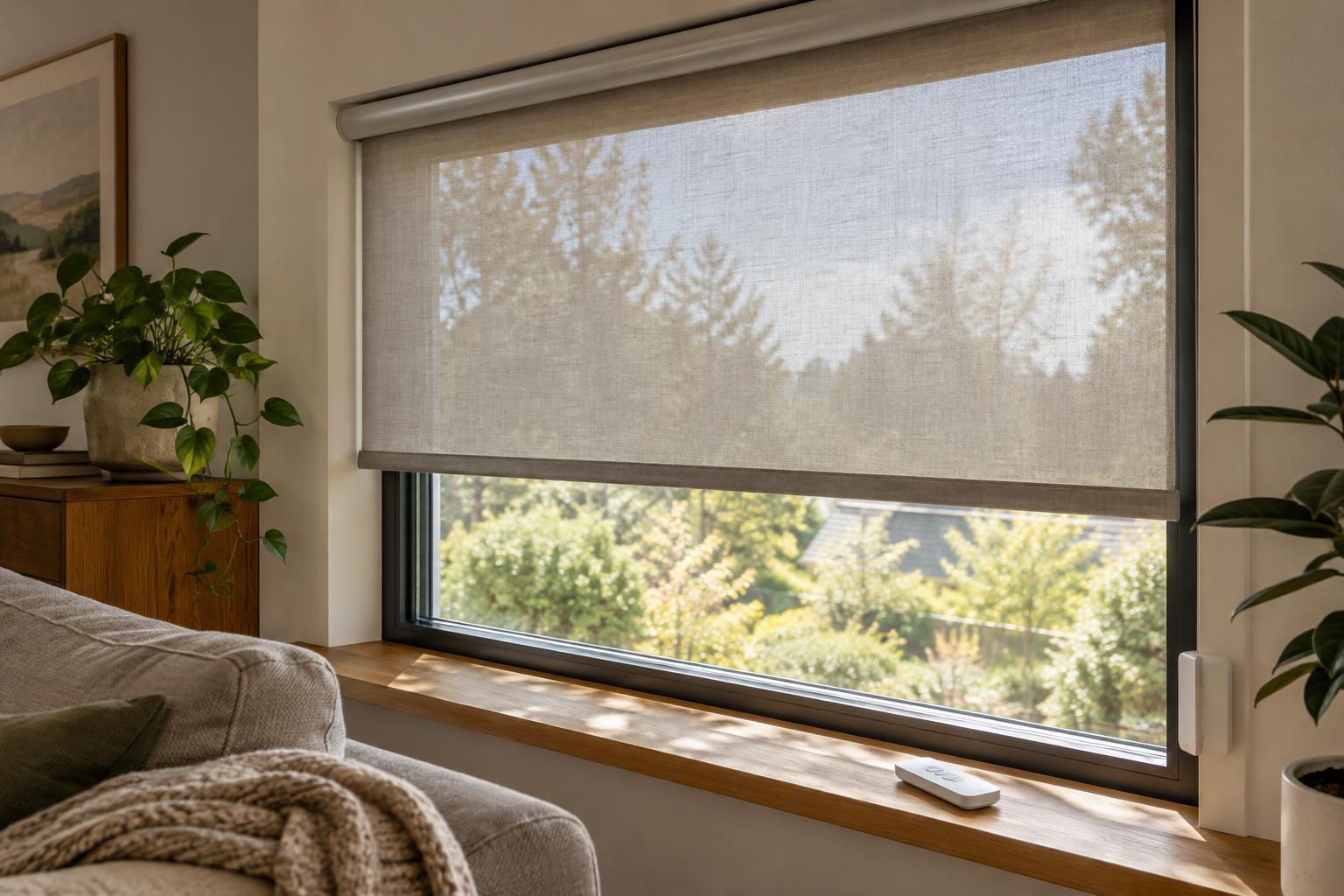
Motorized roller shades commonly place a tubular motor inside the roller. Other designs use a motor in the headrail or a drive unit attached to a track. Retrofit devices may turn an existing beaded chain or wand instead of replacing the entire covering. Retrofit options can reduce the amount of hardware you replace, but they depend on the condition and compatibility of what is already installed. Check the covering’s dimensions, weight, and operating mechanism against the motor’s stated limits.
Choose a power source that suits the window
Battery power is often convenient for finished rooms because it avoids a power cable at the window. Some products use replaceable batteries; others have a rechargeable pack that must be reached for charging. Before buying, picture how you will access the pack when the shade is fully installed. Battery life varies with the covering’s size and weight, how often it moves, and the product’s design, so treat advertised estimates as a planning guide rather than a guarantee.
Wired power avoids routine charging but takes more preparation. Some systems use a low-voltage supply, while others may require a different electrical arrangement. Confirm the product’s requirements, where its cable can run, and whether the supply will remain accessible. Electrical work beyond a simple plug-in setup is best left to a qualified installer. A compatible solar charging accessory can help at some windows, but its usefulness depends on placement and available light; it does not remove the need to check how the battery is maintained.
Decide how you want to control the shades
A handheld remote or wall-mounted button is a useful baseline: anyone in the room can operate the covering without finding a phone. An app may add schedules, groups, and preset positions, such as a partly lowered setting for afternoon glare. Voice control and sensor-triggered routines can be convenient, but consider whether they solve a real problem in that room. For example, a schedule may be simpler than adding a light sensor where sunlight changes unpredictably.
Check how each control reaches the motor. Some products connect directly to a remote; others rely on a hub, Wi-Fi network, or cloud service for particular features. Terms such as Zigbee, Z-Wave, Thread, and Matter describe different parts of a connected-home setup, not a promise that every feature will work with every controller. Verify the specific motor, bridge if required, and desired functions together. Also ask what still works if the internet is down or a hub is unplugged.
Plan the installation before ordering
Measure each window according to the covering manufacturer’s instructions, including the available depth for an inside mount and clearance for handles or trim. Note which side needs access to charging, buttons, or wiring. If several shades will sit side by side, think about whether small gaps between them are acceptable. A motor must have enough capacity to move the covering reliably, but a correctly rated motor will not fix a bracket that is loose or a shade that binds.
After installation, many systems need their fully open and fully closed positions set or calibrated. Test a complete travel cycle and listen for strain or rubbing. Keep furniture and objects clear of the shade’s path. In homes with children or pets, favor cordless designs where possible and follow the manufacturer’s safety instructions for any remaining chains or cords. Keep a way to operate essential coverings if the preferred app or automation is unavailable.
Compare the whole setup, not just the motor
A sensible shortlist begins with three questions: Does the motor fit and move this covering? Can you power and maintain it at this window? Can everyone who uses the room control it comfortably? Then compare noise, available preset positions, grouping options, and the steps needed to replace a battery or motor. These everyday details may matter more than a long list of integrations.
For a single hard-to-reach window, a remote-controlled battery shade may be enough. For many windows, grouped controls and a consistent power plan may be worth more effort. If you want automated routines, confirm the required components before ordering rather than assuming an app label tells the whole story. Matching the motor, power source, and controls to the room will usually produce a more useful result than choosing on connectivity alone.